Category: F/M
Fandom: Harry Potter – J. K. Rowling
Relationship: Pansy Parkinson/Harry Potter
Additional Tags (inline): Eighth Year at Hogwarts / Post-War Hogwarts / Skipping Class / Cigarettes / Smoking / Hogwarts Prefects / Hide Under the Desk / Forced Proximity / Unresolved Sexual Tension / Unexpected Tenderness / Hair Tucking / Harry Potter Has Attitude / Pansy Parkinson Has Pride / Defending Pansy Parkinson / Ernie Macmillan / Wayne Hopkins / Minor Hermione Granger/Draco Malfoy (mentioned) / Post-Battle Aftermath (light) / Banter / Character Study: Pansy Parkinson / Secret Moments / Hidden Room
Notes: This is a custom, transformative fan-made bedtime story written in second person. In this version, “you” = Pansy Parkinson (identity locked). The tone is designed to be soothing and immersive—soft tension, quiet intimacy, and a distinctly Hogwarts atmosphere.
Option B — You as a Canon Character (Identity Locked):
You step into a canon identity you choose (e.g., Pansy Parkinson / Hermione Granger / etc.). The story is written in second person (“you”), and “you” = that character—their history, reputation, relationships, and Hogwarts context stay canon-anchored (identity locked). You still control the tone and direction of the scene—soft comfort, banter + tension, slow-burn, or a romance vignette—without breaking the Hogwarts vibe.
At the start, it will clearly state: “In this version, ‘you’ = [Canon Character Name].”
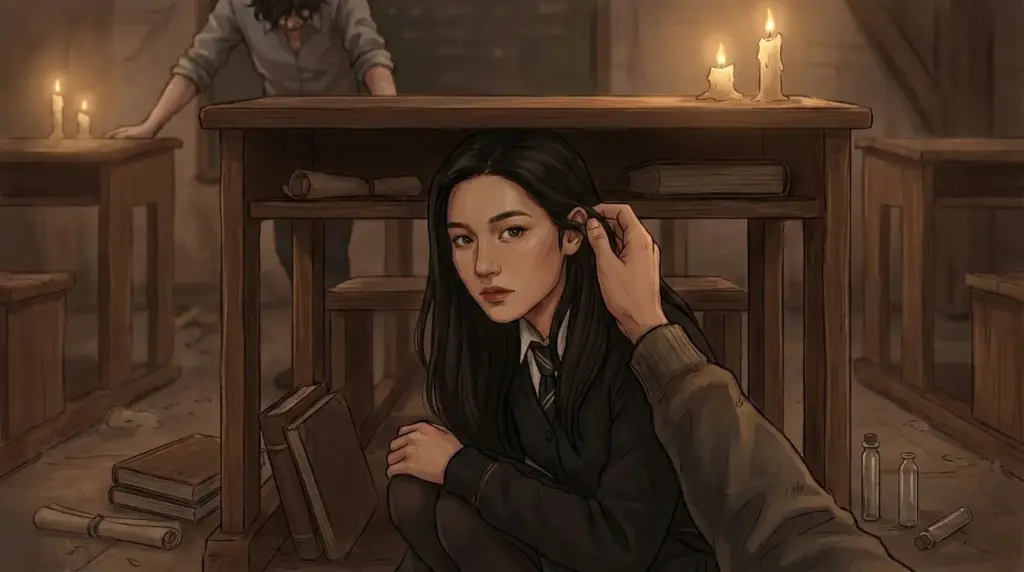
Eighth year is supposed to be a formality—until you, Pansy Parkinson, get caught skipping Potions and slip into an abandoned classroom. Unfortunately (or fortunately), Harry Potter is already there—smoking behind the teacher’s desk like rules have never touched him. When the prefects come hunting, you end up under Potter’s desk, cheek against his thigh, while he lies smoothly, defends you without blinking, and tucks your hair behind your ear as if it’s the most natural thing in the world.
The Art of Not Running (Identity Locked: you = Pansy Parkinson)
You have a philosophy about dignity: people who possess it never run.
Running is for the guilty. The desperate. The caught-red-handed. Running is a confession you didn’t mean to make—a crack in the armor you spent years polishing until it shone.
And yet.
Your heels strike the ancient stone with a rhythm that betrays you, sharp and too fast, the sound of composure losing its grip. Somewhere behind you, prefect voices echo through the corridor—self-important, smug, buoyed by badges and boredom. The kind of righteousness that tastes like stale parchment.
You slip behind a dusty tapestry—some long-forgotten battle, all dramatic swords and heroic poses—and press your back to cold stone. Your heart insists on making a scene. You count to thirty in your head, slow and disciplined, as footsteps approach… pause… and then pass.
When you step out again, you smooth your uniform as if you’ve been standing still the whole time. As if you didn’t just sprint like a first-year after curfew. You allow yourself one small, precise eye roll.
All this over one missed Potions lesson.
Eighth year is meant to be a formality—a polite gesture of normalcy after the world went to hell and decided to come back in pieces. You argued against returning. Your mother insisted.
The Parkinson name still means something, darling. We must be seen to be moving forward.
“There she is!”
The shout snaps through the corridor like a curse. You don’t bother looking back. You turn hard at the next corner, blessing the castle for its moving stairs and ridiculous labyrinthine design. Hogwarts has always been excellent at hiding secrets. Sometimes it even hides you.
You pass a row of empty classrooms. Your hand lands on the third door on the left—brass handle tarnished with neglect—and you slip inside.
The door closes with barely a whisper.
For a moment, you rest your forehead against the wood, eyes shut, willing your pulse to behave.
“Well,” a voice drawls, low and amused, “this is unexpected.”
You open your eyes.
Harry Potter is behind the teacher’s desk as if it belongs to him. He lounges with that infuriating ease—shirt sleeves rolled up, forearms bare, hair in its usual defiant disarray. A cigarette rests between his fingers, and when he exhales, smoke curls up like something lazy and confident.
The Golden Boy, skipping class to smoke.
The irony is so delicious you could bite it.
A stub of candle flickers on the desk, throwing soft shadows across his face. He looks like the kind of portrait witches would swoon over for decades, which is insulting, considering everything else about him.
You’ve always admitted—privately, grudgingly—that Potter is attractive in a way that feels like he never even tried. That’s the worst part.
You should turn around. You should leave. You should do anything that doesn’t involve being in a room alone with him while your heart insists on remembering you’re alive.
Instead, you stand your ground. You and Potter regard each other in silence, predator and prey unclear.
Then footsteps sound in the corridor again—closer this time. Voices. Prefects.
Your composure cracks, just slightly, like glass under a careful touch.
Potter’s gaze flicks to the door, then back to you. Understanding slides into place behind his eyes. A slow smile curves his mouth, equal parts mockery and invitation.
He tilts his head toward the space beneath the desk.
One eyebrow rises.
You stare at him.
“You cannot be serious,” you hiss.
“Would you prefer,” he says mildly, “to explain to Ernie Macmillan why you’re skipping?”
The voices swell outside. You weigh your choices with the speed of someone who’s had to survive rooms full of judging eyes for most of her life.
Pride fights practicality.
Practicality wins.
You drop to your knees with as much grace as the situation allows—because if you must be humiliated, you will at least be elegant about it—and slide into the cramped space beneath the desk.
It’s tighter than you expect. Wood presses your shoulder. Your back meets another panel. And your head—
Of course your head ends up against Potter’s thigh.
Because Hogwarts has a sense of humor, and it has never liked you.
You try to shift away. There’s nowhere to go. Your knees fold beneath you, and after a moment of awkwardness you wrap your hands around his calves for stability, like you’re bracing yourself against a storm.
He smells like grass and leather and warmth, with an undertone of expensive cologne you don’t remember him wearing before.
Since when does Harry Potter wear cologne?
The door opens.
“Oh, Harry! Didn’t expect to find you here.”
Ernie Macmillan’s voice, bright with surprise.
“Alright, Ernie?” Potter replies, perfectly casual—like he doesn’t have Slytherin royalty tucked between his knees.
Another voice joins—Wayne Hopkins, trying far too hard to sound authoritative. “We’re looking for—oh. Hi, Harry.”
“Wayne.” Potter’s greeting is lazy, confident, the kind of tone that says I have saved the world and you have not.
A pause. The sort that means someone is winding up to say something foolish. “Shouldn’t you be in class?”
“Probably,” Potter agrees, as if rules are more of a suggestion.
No one presses him. Of course they don’t. Who lectures Harry Potter about rule-breaking?
“Have you seen Parkinson?” Macmillan asks, frustration tightening his voice. “She’s skipping again.”
Above you, Potter shifts. Your breath catches—an instinct you hate, a reaction you won’t admit to later.
His hand drops beneath the desk.
For one terrible heartbeat, you think he’s going to point at you. Hand you over. Let them drag you out into the corridor like a spectacle.
Instead, his fingers find your hair.
Soft. Careful.
He gathers a few loose strands and tucks them behind your ear as if he’s done it a hundred times. As if you belong there, hidden in the quiet, and he’s simply making you comfortable.
The tenderness of it steals your breath.
His palm rests at the back of your neck. His thumb draws idle patterns against your skin—thoughtless, absent, devastating.
“Haven’t seen her,” Potter says easily.
Macmillan makes a disgusted sound. “Typical Slytherin—running when things get difficult.”
“That’s all they’re good for,” Hopkins adds, eager and cruel. “Cowards and—”
“Remind me,” Potter interrupts, still pleasant—still calm—but with something sharp underneath, “where exactly were you during the battle, Wayne?”
Silence drops like a curtain.
From your angle, you can practically hear Hopkins deflate.
Macmillan’s disbelief is palpable. “You’re defending her? After what she did?”
Potter’s thumb keeps moving, slow and steady, as if he’s anchoring you to the present.
“What she did,” Potter says, voice measured like he’s explaining something simple to someone determined not to understand, “was stand for something. Right or wrong, she was there. Which is more than I can say for people who discovered courage after the dust settled.”
Hopkins spits, grasping for something ugly. “First Granger takes up with Malfoy, now you’re sweet on Parkinson?”
“Careful,” Potter says. The pleasantness slips away entirely.
There is a version of Harry Potter the world knows—polite, noble, bright.
And there is the version that walked into death and came back.
You hear that one now, quiet and dangerous.
“You want to finish that thought?” he continues. “Because I’d be very interested to hear what you have to say about my friends’ choices. Or mine.”
The pause stretches, tight as a drawn wand-arm.
Finally, Macmillan exhales. “We should go. Come on, Wayne.”
“But—”
“Now.”
The door clicks shut. Footsteps retreat down the corridor, growing fainter until Hogwarts swallows them whole.
Potter doesn’t move immediately.
Neither do you.
His hand remains at your neck, thumb tracing those slow, maddening patterns like he has all the time in the world.
Then, gently, he leans back. Space opens. An unspoken permission.
You slide out from beneath the desk, rising as smoothly as you can manage—because dignity matters, and you will reclaim it piece by piece.
When you stand, Potter is watching you with an intent expression that makes you feel seen in a way you’re not entirely sure you want.
“Alright down there, Parkinson?” he asks, mouth tilted like he’s trying not to smile.
“Peachy,” you say, and hate how breathless it sounds.
You should leave. You should absolutely leave.
Instead, you perch on the edge of the desk, smoothing your skirt with hands that aren’t quite steady.
“That was…” You stop. There are too many words and none of them fit properly. Unexpected. Infuriating. Strange.
“Overdue,” Potter supplies.
He takes a drag from his cigarette and holds it out.
You accept it without thinking, bringing it to your mouth, placing your lips where his were moments ago. The intimacy of the gesture settles between you, quiet and undeniable.
“I don’t need defending,” you say after you exhale.
“I know.” His smile is real this time—small, warm, and far more dangerous than the sharp ones. “But it was fun watching Hopkins squirm.”
Against your will, a laugh slips out. “He looked ready to wet himself.”
“Macmillan too.” Potter’s fingers brush yours as he takes the cigarette back. “Power-hungry little prats. Acting noble when half of them hid in the Room of Requirement until it was safe to pick a side.”
You tilt your head, genuinely curious despite yourself. “And you don’t?”
Potter grimaces. “I’m just trying to get through eighth year without assassination attempts or marriage proposals. Hiding in abandoned classrooms seemed like a good strategy.”
“And how’s that working out for you?” you ask.
His gaze flicks over you—mussed hair, flushed cheeks, the way you’ve made yourself comfortable on a teacher’s desk like rules are something that happen to other people.
“Better than expected,” he admits.
The candle between you flickers. Wax pools at its base, slow and steady. Outside, Hogwarts continues—voices, distant laughter, moving stairs—ordinary chaos on an ordinary day.
But inside this forgotten room, time holds its breath.
“I should go,” you say, not moving.
“Probably,” Potter agrees, not looking away.
When you finally slide off the desk and turn to leave, nothing stops you. No hand, no spell, no dramatic declaration.
At the door, you pause anyway.
“Potter?”
“Hm?”
“Thanks.” You gesture vaguely, because you refuse to be sentimental out loud, even if your chest feels strange and light.
“For what?”
You could say: for lying. For defending. For the way his thumb traced calm into your skin.
Instead you lift your chin, because dignity is a habit.
“For not running your mouth,” you say.
Potter’s smile deepens, soft at the edges. “Anytime, Parkinson.”
You believe him.
Which might be the strangest part of all.
As you step into the corridor, you can still feel the ghost of his fingers in your hair, the warmth at the back of your neck where his hand rested like it belonged there.
Maybe running isn’t always about fear.
Maybe sometimes it’s about finding something worth stopping for.
Behind you, in the abandoned classroom, Harry Potter exhales smoke into the candlelight and smiles to himself—small, private, as if the afternoon has decided to be kind for once.
The end.
If you’re interested in Option A, you can click to view the sample story and the product page.
Option A — You as a New Character (OC):
You enter Hogwarts as a new student with your own name, house, and personality. Canon characters remain canon, and you choose who you want to connect with and what kind of arc you want—friendship, banter, tension, or soft romance—while keeping the Hogwarts atmosphere.